-
Here you can find reviews of both Manga and Anime alike. Find even comparisons between the two!
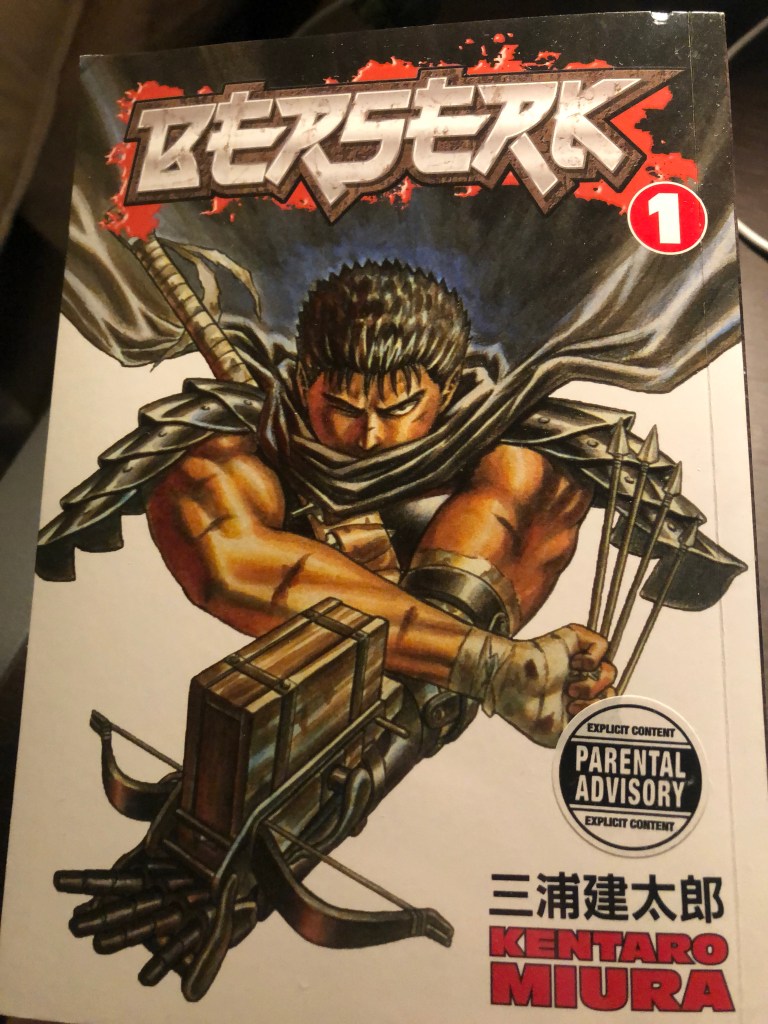
Front Cover of Kentaro Miura’s Berserk For the very first week, we’ll be diving into one of the most influential manga of all time, Berserk. Today, we look at it’s masterfully horrific yet artistic beauty within the male consciousness. Our first introduction to the titular main character guts has a rather animalistic feeling.
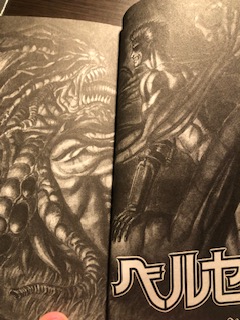
Our first interaction has us assume a typical stereotype for male main characters: muscle bound heroes that only think about sex and attraction. The text sets you up early on to think Guts is a typical male symbol of anger and violence, only boosted by contrast hiding his face and most human characteristic, his eyes. We are led to believe that Guts is a monster in his own right, his own demon. Yet, the rest of this series shows how male violence is created and nurtured within man, not born, and uses the demonic and shocking opener as a gruesome reminder of the fragility of the human mind.
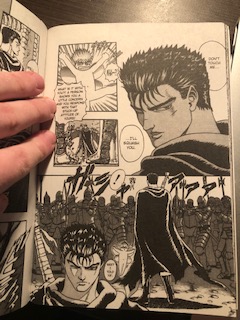
Next we see our young protagonist after he saved a tavern from a band of local thieves. An elf was part of their quarry and represented the people who thanked him for his help. Guts was only cold in his response, not even welcoming the friendly elf to touch him. The proximity within this development and his capture as seen by the guards around him, accompanied by a berating input by Puck, the elf, illustrates a coldness toward humanity and feelings. As the first time we see him even get touched by another caring being, he is locked up in a cold dungeon with no hope. This proximity helps the reader to get a clue of Guts isolation and pain when dealing with those close to him.
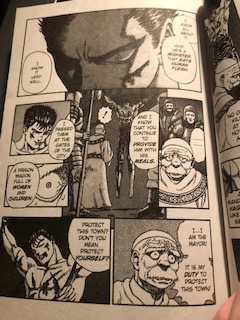
Here we see great uses of contrast once more. In the shading on Guts’ face we really believe he’s had experience. We feel his memories through the shading and it’s as if we’re supposed to believe he himself is a monster to combat his own monsters. The shading delivers again in the final panel when he himself judges the town mayor for his actions. Guts, as violent and crude as he is, feels superior to the mayor because Guts knows he would never give up one very thing, his humanity. This is shown through the contrast, where he represents a Jesus Christ figure, strung up for his own heavy sins, highlighted with light in a dark void, yet he still doesn’t pervert goodness. Guts represents the base makeup of humanity: survival. Above all else, Guts has learned that survival is number one.
That wraps up the first half of chapter 1 in Berserk! I hope you enjoyed my analyses of Kentaro Miura’s Berserk based off of Robin Williams’ “The Non-Designer’s Design Book!” Tune in for the next part of chapter 1 soon!
Works Cited
Williams, Robin. The Non-Designer’s Design Book. Peachpit Press, 2014.
Miura Kentarō, et al. Berserk. Dark Horse Manga, 2019.
 MangaAnimeByClark