So this week, me and fellow blogger Paige Drews watched the pilot episode of the Netflix original anime, Blue Period. Beforehand, we talked extensively about McCloud’s ideas and how they can be connected with anime. We started by focusing on the sections that highlighted Japanese Comics or Manga as a starting point. Then, once we knew what styles of McCloud to look for, we watched the episode together with screen share. Here we could stop the episode and talk about what we both saw in that moment. Paige has a background in actually drawing Manga, as well as animation. Her unique perspective was something that allowed us to create a unique discourse, as I had taken art classes that taught me the basics of a lot of McCloud, and my vast intertextuality with other Manga and Anime allowed me to easily find connections to art styles! The first image we tackled was at the timestamp 5:28

Here, the main character Yaguchi is caught marveling at the painting. Ayukawa, the blonde girl, is mocking Yaguchi for his limited views on art. Seeing him as a more masculine figure, he becomes an other in this situation, his masculinity becoming a weakness. For, the McCloud concept I thought rang true here were his rumblings on impressionism on page 122. McCloud describes this art style as the real world is what the artist sees and thusly depicts. Yaguchi has been pondering his life so far. Pushed to academically achieve all of his life by his parents, he felt disenfranchised with the school institution. This reflects a common crisis of work burnout and suicide rates soaring in Japan. Children are expected to work continuously all throughout their lives in order to support their parents in a society that demands work crunch.
The artist is depicting this phenomenon through Yaguchi’s world view. He is burnt out like society, but finds a revelation in art. The artist is pointing to their view of real society as being one where the individual can pursue artistic passions no matter the skill level. As doing as one wants is the ultimate truth, that’s what brings us back to the image. The most realistic animated object is the painting. It’s almost as if a real oil canvas is on the screen. In contrast, Yaguchi and Ayukawa are animated with very light facial features, closer to that of 71 of our pyramid! With Ayukawa holding ugly CGI busts, our attention is drawn to specifically how the realist painting, which awakened the truth about art within Yaguchi, is the truth within the background, as it posts Yaguchi to be artistic in the doubting Ayukawa’s mind.
I will admit in our conversation here I absolutely dominated the conversation. I really liked the link to impressionism and how the very truth of art is what awoke Yaguchi.
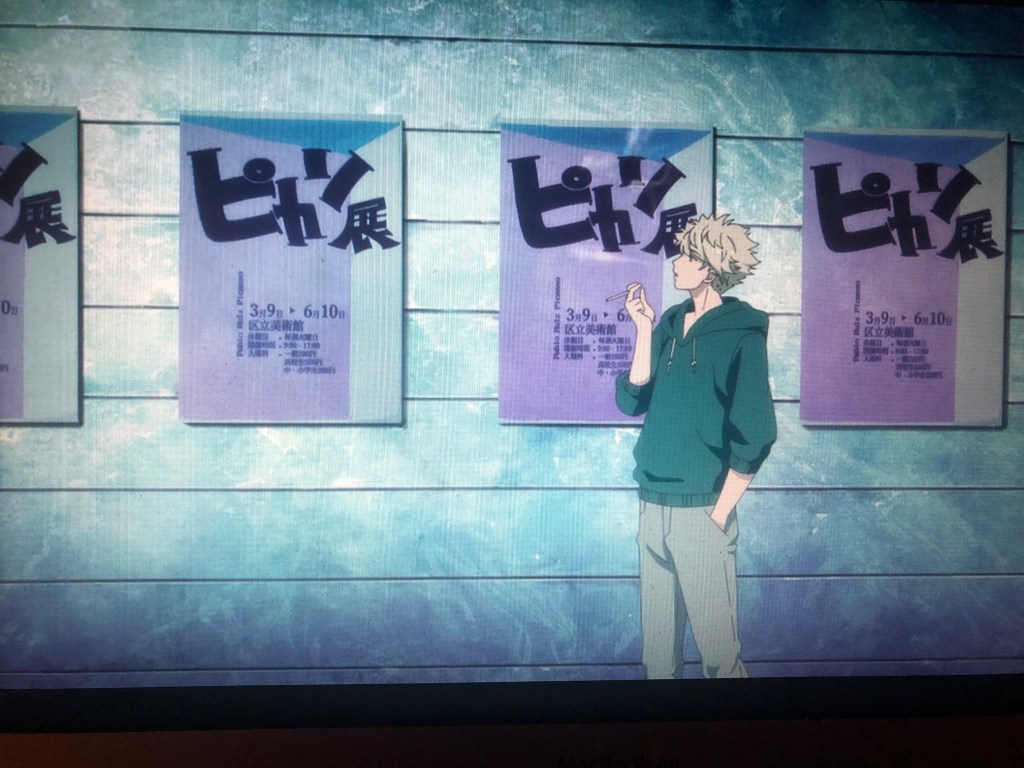
For this image, we absolutely both agreed on this being an example of an aspect-to-aspect transition! On Page 79 in McCloud, he details this technique commonly used in Japanese Comics. They “establish a mood, or a sense of place, time seems to stand still in these quiet, contemplative combinations. Paige pointed this one out to us! I was looking at the initial blue period but, it didn’t quite sink up to an aspect-to-aspect transition. This one specifically shows it by transforming the imagery to blue. The posters say “Pablo Picasso Exhibit” on them, and when Yaguchi was performing masculine tasks, they were read in the past. When the aspect changes, and the color shifts to blue, drowning out all the red, it made the viewer feel as if Yaguchi was in this one spot for hours. We start to see Yaguchi implement what he’s heard from his art teacher and Ayukawa. The moment lasts because it’s his first foray into art. He is seeing the truth in his world for the first time. And the aspect transitions only reinforce this. It’s where the momentum of the episode is generated!

I picked this one again because I really enjoyed the implementation of McCloud’s ideas on lines! Paige pointed out how the lines at the bottom are the “passive and timeless” lines. I mentioned how this progresses to the next two stages, especially dynamic and changing as Yaguchi’s first experience with creating his own art, or truth, is an exploratory one!
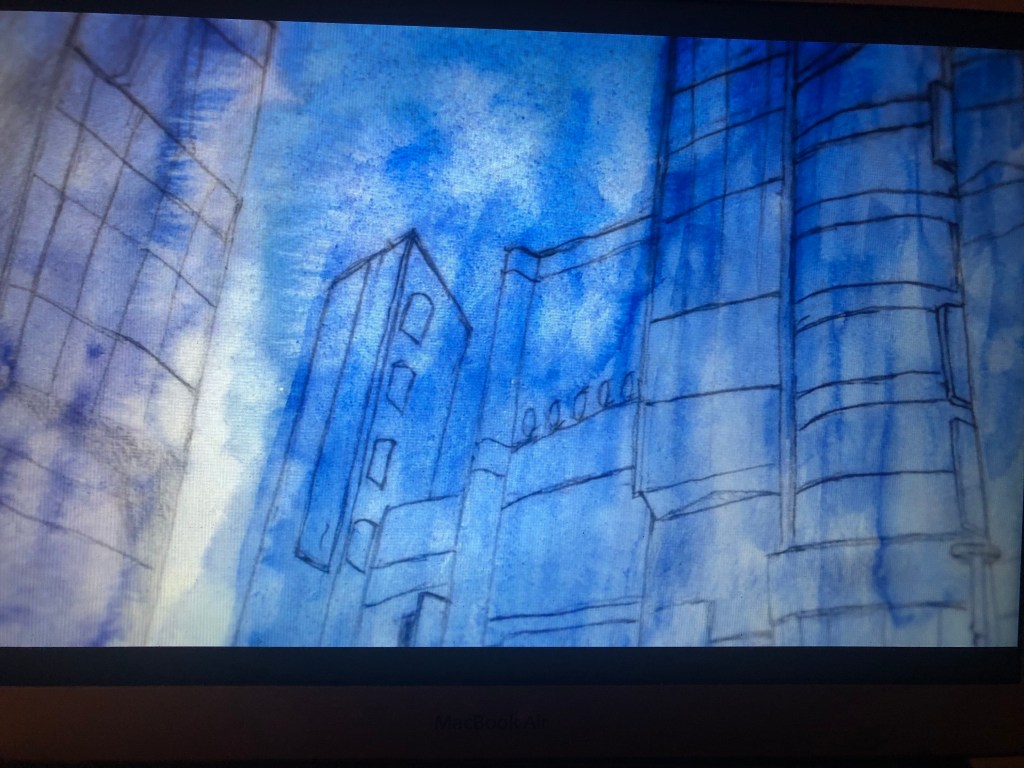
Paige really liked the emotional effect of this final shot of Yaguchi’s completed first painting. His words here are this is the first time I’ve felt alive. Paige quickly pointed out how this painting represented the power of line and color Kandinsky at the top of page 123. Yaguchi’s completed painting displays the mixture of placid blues and cool greens with anxious textures and quiet lines created by pencil. Yaguchi captured the emotion with color, and the quietness yet anxiousness at finding the truth with the quiet lines and anxious textures respectively!
This was a fun experiment to do with Paige! It felt good to see someone else’s face and have a conversation on class material! Paige having actual experience with Manga and Anime was a treat to see! It felt really helpful to bounce ideas off of each other to help out with our understanding of McCloud’s teachings.
Works Cited
Awakening to the Joy of Painting, Blue Period, episode 1, Netflix, 2021, Netflix
McCloud, Scott, and Mark Martin. Understanding Comics: The Invisible Art.
William Morrow, HarperCollinsPublishers, 2018.
 MangaAnimeByClark