The reading this week that helped me apply a new type of approach to reading was Gillian Love’s Researching Visual Materials. In this essay, love designs new ways in which to critically approach a multimodal format of images. In it she describes 3 sites of meaning, those being the site of production, the site of the actual image itself, and the site of the audiences. Love also adds that primarily, site of production is used as it shows the details behind the creation of an image. That’s why this visual analysis of Berserk primarily focuses on the site of production. Using the site of production allows us to take a different look at the beginning of Berserk.
Site of Production
Love describes the site of production as the means behind a visual pieces creation. The time, and technologies available have everything to do with the meaning that certain visual images produce and Berserk is no exception. Luckily, the means of physically producing a manga have gone relatively unchanged in the years since its creation. The typical method would be to sketch out the storyboard with pencil and fill it in with pen once the final changes are made. The use of pencil then pen, transfers to photocopying which easily allows mass distribution. Giving Miura the use of a pencil is usually heavily shown in the images. Much of Berserk is heavy, contrasted lines with whitespace. This ease of access allows Kentaro Miura to show the depressing oppression represented throughout Berserk. The heavy strokes of pencil combined with the overlaying pen shows how the world we live in is only produced by those that control it.
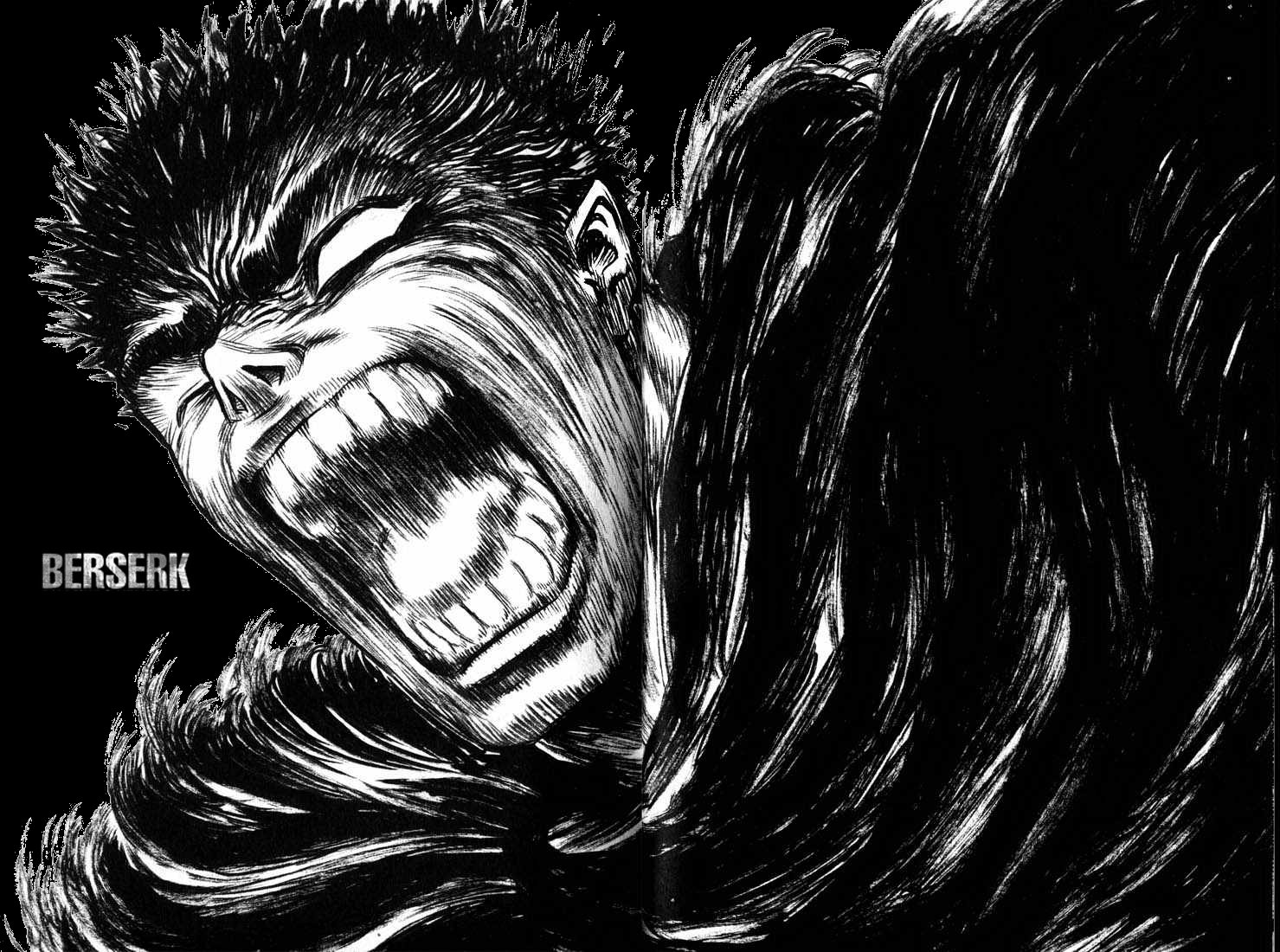
Berserk specifically came out in 1988, however Miura did create a prototype whilst in college. Miura joined the art college of Nihon University in 1985, and for the school manga’s 7th competition he submitted his prototype of Berserk. It’s important to note that he created it under the circumstances of this competition for his school. This means he was honor bound to submit only his finest work, as japanese tradition would mean he strives for his best. Eventually winning second place, the judges agreed. This meant that Miura was specifically using the tools taught to him at his school. The time meant that what was taught was bombastic art with serious messaging to reach out to new manga readers.
This piggy backs into the further aspect of production. The compositionality. Berserk, as previously mentioned, was created in 1988 by Miura for a competition. This competition was was run through a company called Hakusensha. The primary manga distributor, and still king to this day, is Shonen Jump. Their meteoric rise in the 80’s thanks to books like Dragon Ball sounded alarm bells in many manga production centers. Hakusensha was no different. Created in 1972 using primarily shojo dominated works, they felt they needed to capitalize on the traditional shonen market after the popularity of Fist of the North Star, the same series that inspired Miura to create Berserk. So, after seeing the prototype in their school sponsored competition, they chose to serialize it.
The compositionality then creates meaning. Hakusensha wanted to break into this market of overly masculine dark fantasy, and Miura dropped the heavy pencil shaded Berserk into the laps. It was production gold at the time of exploding manga. The horror genre capitalized on the frenzy to reach as mature an audience possible. Miura, capitalizing on the new fever for mature adult oriented manga, was then unafraid to go over the top in his visuals. Attracting viewers world wide with shock factor was Berserk’s big advantage, and the time, being relatively early on in the history of manga, and using his detailed, messy, gritty visuals helped to real in a new era of fans that learned manga can be anything, to even an overly dark gruesome sexual fantasy.

The final site of production that helped to feel the meaning behind Miura’s early work on Berserk is that he was, at the time, working as an assistant/understudy of Buronson. This is one of the pen names for Yoshiyuki Okamura, the creator of Fist of the North Star. So the person that wrote the book that prompted Hakusensha to stick it’s leg into the shonen style, and the manga that inspired Miura, is at the head of the creation of Berserk. Okamura was famous for his works, like the aforementioned Fist of the North Star because he always captured a post apocalyptic feeling. This sentiment towards apocalyptic descriptions is heavily present within Berserk as well. Take it from a society who’s most influential film, Godzilla, is about the nuclear attacks on Hiroshima and Nagasaki. This was a heavy sentiment felt by the japanese in the post war era. They felt as if they had come out of hell, similar to Guts in Berserk, and had to find a meaning and purpose to rebuild. This feeling of causality, and always fighting against the pain, to keep struggling against reality is how many japanese mangaka grew up within the world.

There you have it! The site of production allows us to look at visual images in new ways. It perfectly outlines the meaning behind Berserk’s horror genre, and why it was created to mean the things it means. It’s a depiction of society dealing with apocalyptic like changes and how these certain disastrous times come to nurture and create young men.
Works Cited
Love, Gillian. Researching Visual Methods.
Buronson, et al. Fist of the North Star. Viz Media, 2021.
Miura Kentarō, et al. Berserk. Dark Horse Manga, 2019.
 MangaAnimeByClark