This week Gunther Kress and Theo Van Leeuwen introduced us to multiple concepts that create meaning within visual design. As I was reading Volume 18 of Berserk, I started to notice many of the same visual patterns and tricks these two were describing. They are artistic interpretations that allow meaning to be construed to the reader! Below are three images that contain pages of Berserk that show how Kentaro Miura utilized the difference between Vertical Scale, Social Distance, and Frame Size to create meaning.

This chapter begins with the rapscallion lad that we saw Guts save in the previous chapter. Like Guts, he is alone as a child and determined to prove his strength, even seeing Guts as a barrier to overcome. In his awe of the Black Swordsman, he gets caught up in Gut’s usual demon slaying where he quickly realizes how out of his league he is. After saving him multiple times, Gut’s finally grabs the boy, revealed as Isidro, and throws him off a hill to protect him from the wheel based demons. The resulting page is shown, where Gut’s elevation compared to Isidro is all that is needed to convey the difference between the two. Yet, even with the vertical scale revealing the difference, it also reveals that Gut’s is secretly compassionate towards children. As the action of being above Isidro makes him godly, he also saved him by putting him downwards, showing how vertical scale creates meaning in position and movement.
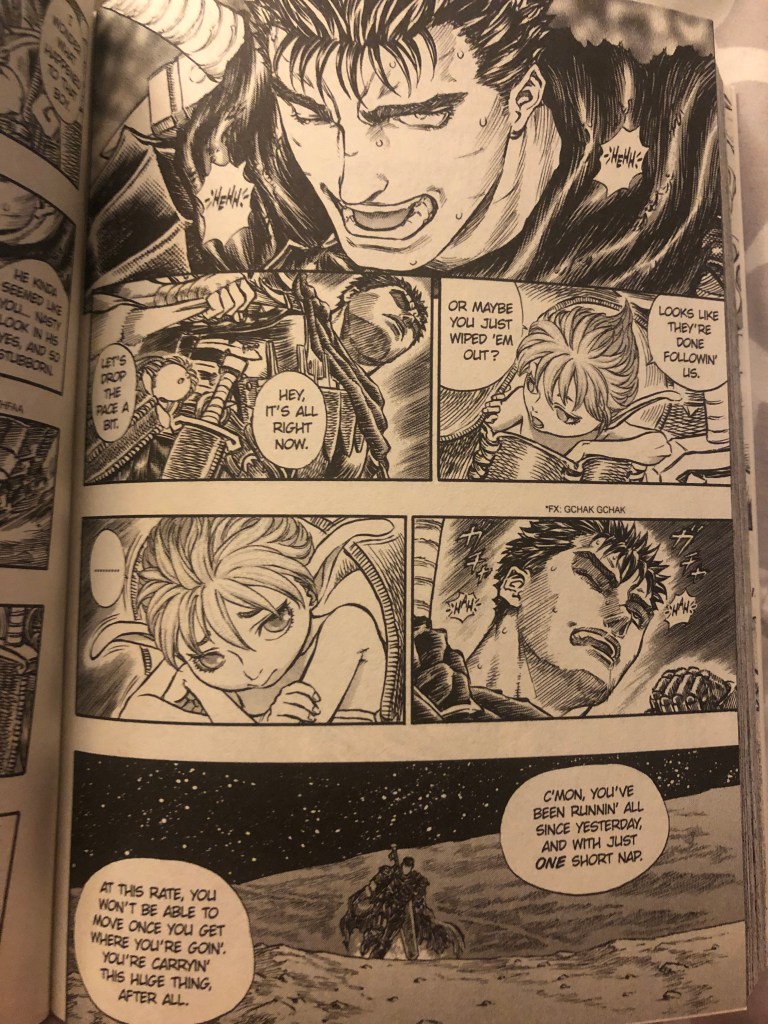
Immediately following the rescue of Isidro and the defeat of the wheel demons, Gut’s begins sprinting again. As his elf friend notes, it’s been a whole day of him running. This page represents social distancing perfectly. In the first panels, we see Guts as he is physically running. We know this because the intimate look we have on just his face shows his sweat and exhortation. As Puck realizes that Guts is still running for no reason, we zoom out slightly to a less intimate look, followed by an intimate focus on the elf Puck as he himself takes a look at Guts. The initial intimacy on Guts, followed by a mid shot, then with intimate shots of Puck analysing Guts sets up the narrative Miura is designing. We are following Puck’s realization of Gut’s feelings through social distance on Guts. At first, like Puck, we just assume Guts is running from the wheel demons. But as the shots widen, the whole picture is revealed. It crescendos into the final shot of Guts with the night sky and rolling hills in the background, as we get a long view of Guts, foot to head. This reveals how Puck, someone that can feel the emotions of others, slowly understands that Gut’s is running to get to his love, he’s sacrificing his body and self to save someone else. His whole world. And social distancing shows us this through the transitions of personal to long shots of Guts.
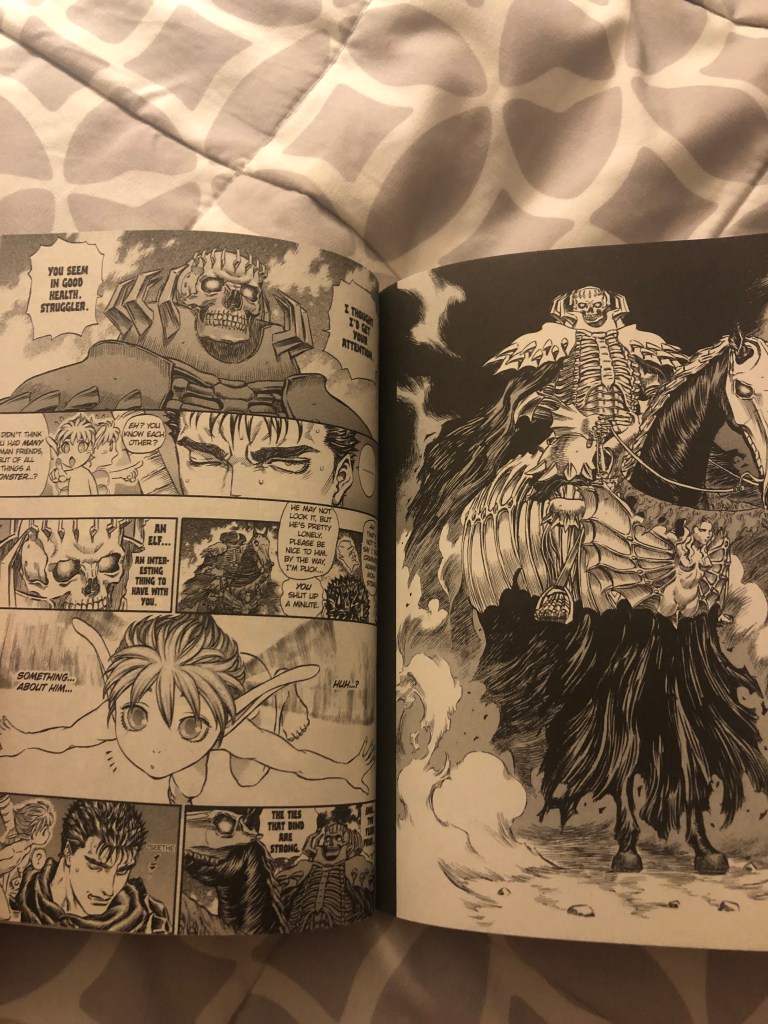
Pages 4 and 5 of Spirit Road(2)
And finally for a little bit of fun, frame size also implements tons of meaning! This is a really cool example because the art of the skull knight is sublime. This page is again from Puck’s perspective, as Guts has actually met the skull knight before. The first page on the right (remember, Manga is read left to right, but the page order is backwards, so you read the right page first) tells us this fact because it presents the skull knight in his usual intimidating fashion. The frame is that of the whole page, signifying his importance to the story. Yet, on the second page, when the skull knight states you’re in good health, accompanied by Gut’s reaction, we know that Puck know sees the Skull knight as a non-threat. The frame size, all of them being quick cuts of just particularly faces, shows the now conveyed familiarity!
Works Cited
Kress, Gunther, and Theo van Leeuwen. Reading Images. Routledge, 1996.
Miura Kentarō, et al. Berserk. Dark Horse Manga, 2019.
 MangaAnimeByClark